
WASHINGTON, Oct. 28, 2026 —
The U.S. Treasury Department sanctioned Rwanda's Ministry of Defence and a Rwandan financial institution, Zigama Credit and Savings Society, on Wednesday, saying both have supported the March 23 Movement (M23), an armed group that has seized territory in the eastern Democratic Republic of the Congo, according to a Treasury press release.
"Today, the United States makes good on President Trump's promise to hold Rwanda accountable for its commitments under the Washington Accords for Peace and Prosperity," Treasury Secretary Scott Bessent said in the release. "Rwanda must halt its support for M23 and withdraw its troops from eastern DRC."
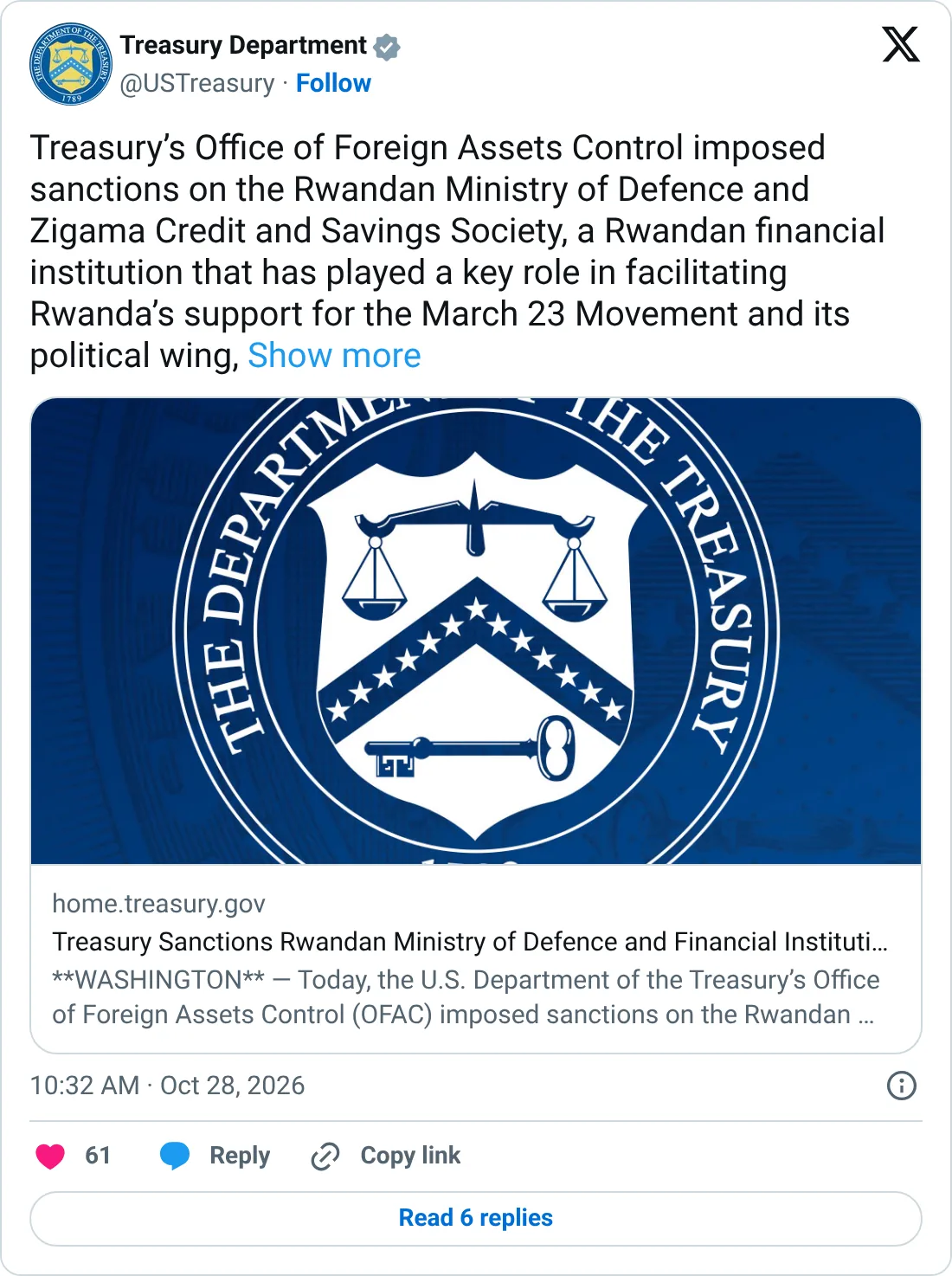
Treasury's Office of Foreign Assets Control (OFAC) added both to its sanctions list Wednesday (OFAC recent actions, Oct. 28, 2026). Treasury announced the action on X at 10:32 a.m. Eastern time.
What Treasury says
- The ministry. Treasury calls Rwanda's Ministry of Defence the umbrella organization for the country's security services, including the Rwanda Defence Force, which OFAC sanctioned on March 2, 2026. Treasury says that at the ministry's direction, the Rwanda Defence Force has deployed thousands of troops in North and South Kivu provinces, where they operate alongside M23 and give it equipment, supplies, logistics and training.
- Weapons. Treasury says Rwandan forces have brought surface-to-air missile systems and jamming equipment to the battlefield, "creating risks for civilian aviation in eastern DRC."
- The bank. Treasury says Zigama operates on behalf of Rwanda's security services, has paid entities in China and other countries for weapons, ammunition and military equipment for the Rwanda Defence Force, and that one Zigama branch helped move gold from M23-controlled territory to Kigali. Treasury says Zigama also handled transactions for M23 and its political wing "amounting to tens of millions of dollars."
- The peace deal. Treasury says the U.S.-brokered Washington Accords were signed by the heads of state of Congo and Rwanda on Dec. 4, 2025.
Both were designated under Executive Order 13413, as amended (Treasury).
What it means for Floridians and Florida businesses
Treasury says any property or interests in property of the sanctioned parties that are in the United States or controlled by U.S. persons are now blocked and must be reported to OFAC. U.S. persons, which includes Florida residents, companies and banks, are generally barred from doing business with them unless OFAC licenses it. Treasury also says financial institutions anywhere could face sanctions risk for certain transactions with them (Treasury).
Treasury says the goal of sanctions "is not to punish, but to bring about a positive change in behavior," and that sanctioned parties can petition to be removed from the list.
Launchpad Digital has asked the U.S. Treasury Department for comment and will update this story when they respond.
Those are the facts, directly from the source.
Sources: U.S. Department of the Treasury press release and X post (Oct. 28, 2026); OFAC recent actions, Oct. 28, 2026.
← More World stories · All Launchpad stories · Spotted an error? Request a correction.